
A Death in the Mountains

A Death in the Mountains
The friendships of climbing partners are famously conflicted. Finding a halfway-decent partner, whether for the crags or for the mountains, is often the most frustrating hindrance to climbing. The absentmindedness of my first (and best) partner, forty years ago, had him often driving to the mountains without a sleeping bag, and yet he laughed aloud at every word that left my mouth, a virtue to be cherished. We once witnessed a married couple in a shouting match as the husband ascended the last of a one-hundred-foot rock pitch. And screaming hoarsely from the ground with bitter exasperation, she untied herself from the rope, and stomped off, leaving him stranded as he crawled onto the belay ledge. Every climber has a bucket list of peaks, routes, and rock climbs that percolate in his imagination, and the likelihood of congruity with any other living climber is so remote as to guarantee that every day in the mountains will exact a compromise on someone’s part. Even the speed at which two partners hike the approach trail to the day’s objective can become contentious. Whatever camaraderie exists between partners usually arises from the communal experience of fear, and fear has the potential of more melodramatic flourishes.
When Greg invited me to join him on the climb of a peak in a part of the Sierra Nevada unfamiliar to me, I immediately accepted. It was far from my first choice of what to do and where to go in the mountains, but Greg was an excellent wilderness traveler, and decent company. Our friendship, such as it was, had started with promise, culminated in a series of false starts, and finally settled into what seemed a permanent condition of diminished expectations. A month early, I changed my mind about the trip, and bailed. A month’s notice was well within the etiquette of such things. Greg was not upset, and he successfully found another candidate, although I was never to know who it was. On their second day in the backcountry, they ascended their target summit. And on the hike back to camp, about a mile distant from the lake where they had pitched their tents, they split up temporarily, agreeing to meet for dinner back at camp. According to the story I had heard, Greg wanted to filter water at the stream where they had parted. From that time on, no one really knows what happened to Greg. He never made it back. He was not seen again until his body was recovered some years later.
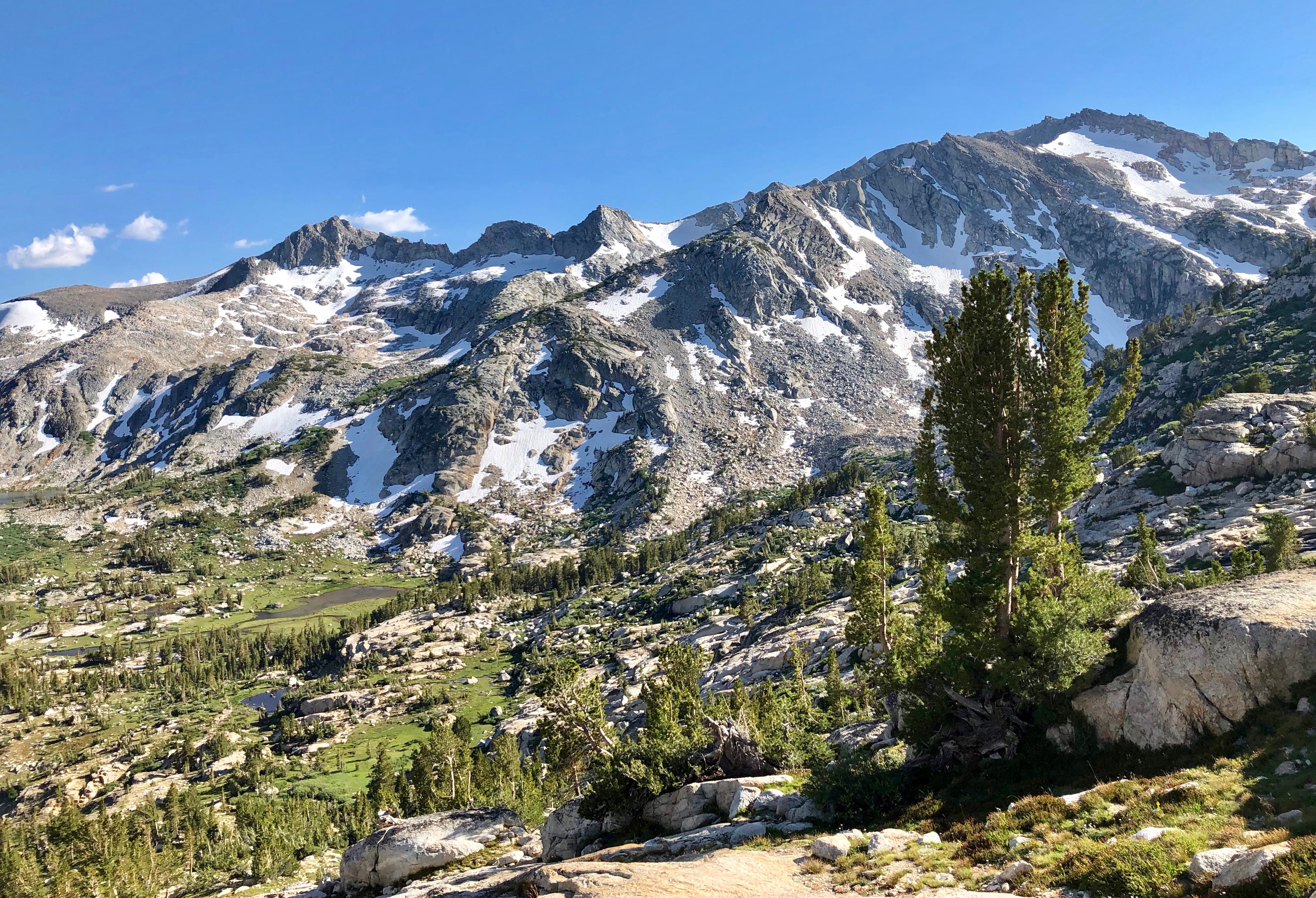
I learned the news of Greg’s disappearance in the initial days of the search, when it was still only a disappearance. I was called by a friend of the family as the SAR teams were scouring the wilderness. I knew very little to help the search, but in the same conversation, I found out that Greg had recently been diagnosed with early onset Alzheimers, an impairment of which I had not heard a hint when we originally planned the trip. He had seemed fine. He had handled all the details, and we had had several back and forths by email and in person. And yet now, apparently, he had somehow wandered into the wilderness. As the weeks became months, the search turned into a body recovery, and then it was abandoned entirely till the spring thaw. Greg had spent a lifetime in the mountains. I remember him in a yoga position inside his tiny tent’s bug netting as I swatted mosquitos. I had never known anyone more at home in the wilderness. The contours of the terrain are sizable and prominent, and the Sierra Nevada in general is characterized by miles and miles of unforested granite. Somehow, we were supposed to believe that a mile from camp, Greg had lost his way.
Because he had taken my place, I still wonder about who it was that entered the wilderness with Greg. It had to have been someone from the gym, someone I knew, but during the same call with the family friend, I was told that he, the partner, had wished to remain anonymous. Whoever it was, he must have suffered through the hours and days of a futile search for Greg, cursed with anguished deliberation about what was the right thing to do, while the landscape expanded in all directions. Eventually he would have run out of food, and grimly hiked out, back to the car without Greg. Did he know of Greg’s condition before the trip? Unlikely. In that case, they never would have split up. He probably found out after he left the mountains and called Greg’s wife. Somehow, Greg’s symptoms must have been manageable before the trip, enough to have considered its undertaking, but then mid-trip, things had taken a catastrophic turn. If I had been Greg’s partner, and had only found out about the diagnosis after hiking out of the mountains, I can imagine having a series of emotions. At first, I’d have felt guilty and responsible for all the mistakes I’d undoubtedly made, searching for Greg—for leaving the mountains without my partner. Should I have persisted in the search for another day or two, gone without food? Those are the questions that would have tormented me, the things I would have thought—at first. But then, in a day or so, after some time to reflect, I think I would have been angry—angry for being put in such a position. Angry, but there was no one to be angry at. How could I be angry at Greg’s terrified wife? So maybe that is why the partner had chosen to be anonymous. It is callous of me, but I can’t help but feel that I dodged a bullet.
Most friendships are the result of compromises we wordlessly accepted long ago and never think about. For Greg and I, there never would have been a time when we got together for dinner with our wives—my wife and I weren’t dinner party people, we didn’t drink, and we were ex-democrats, unwanted guests at every table in Berkeley. Among the older, more professional set of men at the gym, I was notorious for odd opinions. And if Greg’s candidness about the most uninteresting subjects could sometimes become tedious on our long drives to the mountains, I forgave him mostly. Greg had that special ability to disagree without losing his temper. Every time our friendship seemed on the verge of a breakthrough, one of us was sure to do something to thwart it—at first perplexing, but then, a pattern. And yet I’m left wondering, despite all, if I might have been the kind of man Greg wanted to be with on the last backpack trip of his life, which, considering what must have been in the foreground of his thoughts, certainly seemed possible.
A few years later I happened to run into Greg’s widow, who told me that Greg’s remains had been found—found many miles away from where he had separated from his partner. The question hung in the air. Why had he walked all that way? She offered no other details. I didn’t expect any and I didn’t ask. So that was that. I stopped going to the gym, and the few times I ran into the men I had known there, they knew less than I did about Greg’s death. One had said, somewhat simply, that, at least Greg had died in the mountains. And I had to admit (though not to him) that I had thought the same thing several times, but never aloud, and not to his widow or any of his friends. He had died in the mountains. And adjacent to this thought was another, more subversive one—a question that I hadn’t been able to get out of my mind since the first news of Greg’s disappearance. What if Greg’s death in the mountains had not been an accident, but an ending to his life of his own invention? Even posing the question seemed reckless.
It is the mark of a good mountaineer who retreats when difficulties arise too fast, when risk becomes unmanageable, when the weather turns in minutes. Once when Greg and I were climbing, I suffered a bout of dizziness from the rapidity of our ascent, just as we were climbing the most vertiginous part of the mountain. And even though we had spent the whole day getting to where we were, he was prepared to turn around for my sake. Few men are so disciplined. Since then, many times in old age, I have resorted to day-long sorties into the mountains by myself, precisely to avoid the encumbrance of a partner. And, in so doing, I have often heard myself say, to no one in particular, to the rocks and trees, that if I were to die in the mountains, there could be worse ways to go. To lose your footing above a drop, to be hit by falling rock, to be caught above treeline with a storm booming on your head. If your alternative was to die over decades with year after year of failing faculties, what could be worse? A slow death of exposure to the elements over days and weeks? Was that really worse? In relation to the actual death of an actual friend, this kind of thinking seems glib, but there it is.
Greg was smart, and had much to dread—and even if his wife had suffered as a consequence of the uncertainty around his violent end, would she not have had fewer years of suffering overall? What if what happened to Greg was part of a plan he made to escape the worst of a fatal diagnosis? When later she and I happened to meet again, and I could see that she had finally begun to put her life back together, I was truly glad for her. Greg wasn’t a prideful man. He didn’t seem the type to escape the suffering of his diagnosis by abruptly ending his life. He never struck me as especially brave as a climber. But it seems possible that he might have formed the opinion that he could rescue some of the years of his wife’s life by doing something drastic. That was the type he seemed to be. It was possible. And looking at how things happened, it also seems possible that his original inclusion of me in the plan could have been premeditated. That he felt I might have had what was necessary to deal with what he had in mind. Maybe in a way that would have been better than his closer friends. Maybe better because our friendship was, really, not as good. In the end, I didn’t go, thank god.
(Working Man is 100% AI-free and free to all subscribers. Posts every other Tuesday)
My condolences.
Your friend met his end in a beautiful place surrounded by God's creation. I agree with you that it was probably his choice.
It's better than the horrors of the nursing home. He died like an old, undefeated buck, having done his part and ready to go.
Thank you for the wisdom and nuance and how you question yourself and Greg.