
Surfing and Dad's Last Year
In Eight Parts

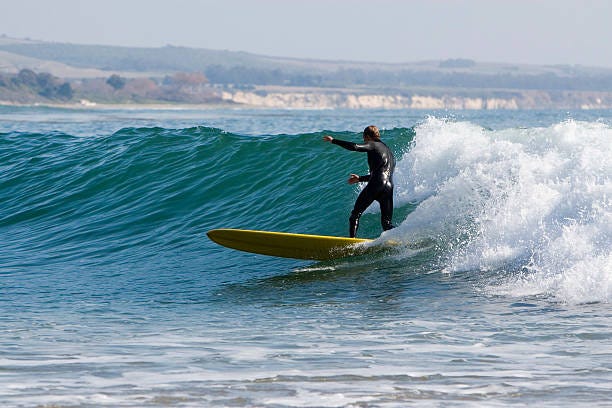
(Dear faithful reader: This piece is in eight discrete parts, each part about a page long. Working Man is 100% AI-free and free to all subscribers. More construction work posts are in process. Thank you—Working Man)
Surfing and Dad’s Last Year
One
In my late forties, with no particular affinity for the ocean or for beaches, I signed up to take a beginning surf lesson. I wish I could remember my original impulse, my feelings before they were muddled by actual events. The lesson was held in the coastal village of Bolinas, an hour north of San Francisco, where we students attempted to stand on our boards as tiny rollers nudged us toward the sand. As I would soon discover, the addictive nature of surfing was a topic up and down the coast of California in all the parking lots of beaches where surfers gossiped as they pulled on their wetsuits and waxed their boards. For many, surfing was not really a sport, but a way of life—and you would hear this sentiment from the humblest of men—men who practiced their devotion by surfing every day, no matter how miserable the conditions. As if mere immersion was a kind of sacrament. And unless you’ve spent those hours in saltwater, you really can’t understand how plausible this sounds. The ocean would work every muscle in my body, and when I finally emerged, clad in black rubber and dripping on the beach, I was so pumped with endorphins, my fatigue was so deep, I felt like my soul had been combed out by the tines of a breaker. Nevertheless—beneath the carefree “aloha” gloss of surfing was a kind of rapacious fury that often erupted in “the lineup.” “The lineup” being that small, sometimes dysfunctional, community of surfers floating out beyond the lines of breaking waves. From the perspective of an observer on the beach, it must have seemed perfectly obvious: What purer expression of narcissism than that ten-second ride at the crest of a wave? And yet, because that ten seconds constituted only a thousandth part of the effort of surfing, most of us looked elsewhere for the source of surfing’s addiction: To the experience of water itself, or more specifically, to the drubbing we habitually received at the hands of the ocean. A wave would hit me, and I was shoved down, spinning into darkness, where I’d receive an education in the raggedy nature of the human body. Waves would come, unrelenting, and I’d dive for the bottom—and the only peace I could make with that wild organism, the primordial sea, was abject submission. When two surfers take leave of each other in the parking lot, there is never a reference to boards or waves, it is always: "See you in the water." The water is the thing.
Two
I suppose I’ve reached that age at which one begins to weigh all future tribulations against the unlikeliness of survival, as if one might hope to thwart dementia by shrewdly expiring before its onset. One of the great inconveniences of being 70 is not knowing whether I should be tidying loose ends or preparing for a siege. My dear father was wholly unready to live to 93. During his last year in the nursing section of the assisted living center, he gave so little indication of what he wanted or didn’t want that for me merely being with him was exhausting. He would look up from his pillow with an impassiveness that was beyond my understanding. After a lifetime of family love and duty, the gap between us had somehow begun to yawn with ambiguity. And I suppose it was my own invention that it was my responsibility to try to fill that gap—and I did, I did try—although, in trying, I began to wonder if it was really something about which he was mostly indifferent. Each time he was removed from his bed for physical therapy, he was completely unable to stand without the aid of the nursing staff. Even so, I got the feeling he had not yet given up, as if in the foreground of his consciousness, he clung to the idea of recovery. As if he was the last one to get the news. And I began to wonder if it was only the irrationality of his optimism that stood between us. When mom’s Alzheimers had settled down enough for her to take a bed in the “memory wing” of the assisted living center—a hundred feet across the breezeway from Dad in “skilled nursing”—his own medical issues had become acute. Until then, he had attended her faithfully every day, although she no longer recognized him as her own husband. He had become the stranger with suspicious good will. In his presence, she would ask the nurses: “Where has my John got to? Have you seen him?” After seventy years of marriage, she had demoted him to some kind of imposter. And when at last she died, it took an effort of imagination to re-conjure for myself the mother she once had been, so that my grief could have some proper residence. The life they had had together, full of love and happiness, was far beyond common expectation, and yet it is hard to pretend that where things end up doesn’t matter. Their marriage lasted seventy years, and they were out of time. The headline of her death became a grim chore we were forced to recount to him over and over. For a man who had probably never been depressed a day in his life, he now certainly had cause, and maybe the gap between us was as simple as that.
Three
You could, without exaggeration, cite the inconvenience of surfing as a source of its addictiveness. After work, I’d check coastal buoys and surf cams, grab my wetsuit, and tie the board to the truck. Then I’d drive an hour to the beach, find a parking place, change into my wetsuit, and paddle out. A middle-age divorce had bestowed freedom and guilt to me in equal measure, and surfing became my solution to the problem of free time. Surfing’s learning curve is steep, and neither the temperament of the ocean nor that of your companions in the water are much disposed to facilitate your progress. Favorable conditions, the near magical convergence of swell, tide, and wind, are so rare that the calendar dates of perfect days become a part of a hardcore surfer’s lexicon. One of the first things you learn as a beginner is that the type of wave that can be ridden on a surfboard doesn’t crash down all at once, but instead—peels—breaking gradually from one end of the swell to the other, and the surfer stands on his board in the steepening but undisturbed green part of the swell, just in front of the push of the white breaking wave. Whatever beach you go to, surfing is at least as competitive as tennis, with an etiquette skewed to the advantage of the better surfers, and ferociously enforced. Parking lot fistfights are not unheard of. And the better the conditions, the more quarrelsome is the mood of the lineup. As a consequence, the same few surfers catch wave after wave while the great majority float sedately on their boards. For a beginner, merely paddling through the lines of breaking waves to the lineup on the outside can be physically grueling, and once in the lineup, it can take all your focus just to sit on your board without falling over. To the casual observer, surfing may seem just a step above sunbathing in the expenditure of energy—a glance at the lineup may produce an impression of idleness—but closer inspection reveals how much energetic paddling underlies that illusion. Since the early days of surfing, the soul of the sport has been a lazy kind of American grace, and surfers are eager to talk about the soul and soulfulness because riding a wave is an expression of style, and the soul of style is grace. On the other hand, to the experienced eye, the world class surfer you see in a diagonal streak across the one-hundred-foot face of a breaking wave resembles nothing so much as a man fleeing for his life.
Four
During the last years of my parents’ lives, my sister and I shared the responsibility of daily visits. It was the middle of covid and all the world was the waiting room of a hospital. It seemed that Dad and I were fast approaching the end of the period of time given to resolving outstanding questions, if such a period even exists. And maybe I should have been willing to forgo my yearning for some kind of reckoning because he, clearly, had no such similar feeling, or so I believed. And yet he was still sharp, his mind still intact. A protestant pastor, he had stood at the bedside of the sick and dying all his life, and I wondered why it was that I had acquired nothing of his experience. The staff who took care of him, who cleaned him and fed him and changed his clothes, they obviously admired him, as people had admired him all his life, a man of considerable gravitas. But now he was so mild, so plainly grateful, so unlike their other patients. For these professionals, who suffered with him through the intimacy of their occupation, all the relevant questions had already been answered. And for him, maybe everything had been subsumed into the imaginary letter he must have been composing in his mind for mom, the one that tried to put a desperate bow on all that had happened, the one that was never delivered. So he must have known exactly what I wanted: knew it and understood it, but simply could not bring himself to do it. Because, I guess, to do so would have required of him to acknowledge his nearness to the end. It is a kind of unspoken commonplace that the claim of the elderly on the world of the living should, in decency, decrease with increasing age, and yet I don’t think Dad was any more prepared to die at 93 than he had been at 73. I say this knowing it contradicts almost everything I thought I knew about my dad, and about my family. We had always been so quick to move past disagreement, so eager for reconciliation. In one night, mom had lost her mind. I remember Dad had called us, something was wrong, and never in my life had I received a call like that from him. When we got there, mom was a muttering old woman who refused to sleep in the same room with dad. These were my parents—I could not recall them ever raising their voices to each other. So, that night, my wife and I slept on the living room floor as mom turned restlessly on the couch, and when we all got up the next morning, everything was dreadfully the same. I began to wonder if Dad had been hiding from us the progress of her dementia, although the idea of my dad doing anything dishonest was unthinkable. The two of them had always been so responsible, and yet, when the time came, they seemed not to understand why their long-held privileges should be relinquished. They held onto the keys to the Camry long after they should have been surrendered. A series of car accidents, concealed from my sister and I, had forced Dad to lose his driver’s license, and because mom could not drive a block from the assisted living center without getting lost, together they had made one very bad driver. With mom at the wheel, and dad giving directions, they got to church, week after week, till it all blew up.
Five
Standing on the beach with a board under my arm and looking out at the surf—if the waves seemed small and playful, I could just start paddling. But if the waves were stacked up, and exploding one after another in heavy sheets of white across the sand, then getting to the line-up required a plan, as well as muscle, timing, and good wave sense. It might even include a full retreat to the beach for more study. Waiting for a lull, I’d wade out chest-deep, and then, when the moment seemed right, I’d slide onto my board and begin to paddle with a sense of purpose, and with the object of spending as little time as possible in the impact zone. Approaching the lines of waves, none would be in the exact same phase of breaking, my only hope was to contend with each in turn, one at a time. Some waves, although very steep, might be only feathering at the top, and if I timed my paddling stroke with a burst of power at just the right moment, I could stay on the board and punch up and over—my board coming down on the other side and slapping the water with a loud crack. But often the waves were in full collapse, and those I’d have to somehow dive beneath, dragging my board with me, and making sure it offered as little surface area as possible to the force of the wave, like a knife. Often I was paddling so hard and the waves were so relentless, I could barely see where I was going—my head was buried in a wash of white. The basic plan was always to try to cross over through the unbroken green water in front of the peeling white wave, racing toward me and roaring like an engine. However, if a surfer happened to be already standing on the wave, etiquette demanded I let him pass and permit the crashing wave slam me with its full force. Often, multiple surfers were paddling out simultaneously, all aiming to cross over at the same spot, and creating a convergence in which one or two would fail to pass, and were compelled to accept a pummeling. If I was unlucky, a wave might pick me up and hurl me toward the beach, or drive me down into its maw. But this violence was always so ridiculously extreme, and resistance so futile, my only choice was to let the wave molest me as it wished. The immensity of the force applied to my body was best accepted with good humor. So very rarely did any part of me actually touch the rocky bottom below the waves that the consequence of all this mayhem was almost entirely theatrical and performative. And I think I began to believe this quality was implicit in the nature of water, as I understood it, because the pantomime of suffering I was forced to enact always felt somehow redemptive and purifying, despite small quantities of saltwater up my nose.
Six
For most of my life, I simply worshipped him, as in the best of all possible worlds, a son should revere his father. Keenly aware of my personal shortcomings in his presence, I would have been hard-pressed to name a single one of his, and his many virtues far outshone any shortcomings he may have had. And yet, being his son, the son of a protestant pastor, I felt my early resistance to faith was more of an unfortunate function of our relationship rather than some kind of reasoned-out obstinacy. Often during the visits with Dad, I’d read Bible verses and prayers to him, although it was hard to tell if he enjoyed them, or whether my more ambiguous relationship with faith somehow compromised the effort in his eyes. In the last month of his life, he was visited regularly by a young black woman who worked on another floor of the assisted living center, and together they conversed with enthusiasm about the meaning of Bible verses, and sometimes sang hymns. He may have been happier in those moments than any other in the life left to him. More than once, he told me that if he could be anything in the world, he would choose to be a protestant pastor—and I couldn’t help but notice how he always phrased it in the present tense, as if it was a choice that could still be made. My sister and I sometimes talked about the young woman, and when I confessed that I was frankly envious of the fervency of her belief, my sister, who never questioned her atheism acquired in college, asked: “Why?”Our partnership in caring for mom and dad had been without contention, despite the fact we lived in different worlds. For most of those years, I had been thinking about and preparing myself for the death of my father, but now that it was imminent, I knew none of my feelings were right. For one thing, I felt so much nearer to him in age than I had imagined: I was in my late sixties and everything that had befallen him, all the mishaps of getting old: the forgetting, the falling, the relinquishment of adult authority, the betrayal of the body, all these felt so near to my own condition, it seemed unnatural that parent and child should come so close to ending in the same grave. When earlier I had anticipated grief, I had thought of it as something surprising, and sharply experienced, a bereavement. I had not prepared for a process extending over months and years, of visits good, bad, and indifferent, so that when the end did come, it came without trumpet calls. It was just another night. I had stayed late because he wasn’t doing well, was breathing rapidly, and we thought maybe the end was near, but the experience we had acquired over months and years had informed us that things usually took longer than we expected. And so, the night he died, I decided to go home at ten pm, thinking I would save my strength for what might come the next day. But when they called in the morning with the news that he had died around five am, and that I had in fact robbed him of the comfort of holding a hand at the end, I felt more guilt than grief. The suffering that he had borne, that my sister and I had attempted to alleviate, had left me so worn out that when his death finally came, grief was nearly indistinguishable from relief.
Seven
The first few times I managed to paddle through the breaking waves to the outside, I elected to bypass the obligation of actually trying to catch a wave, and among dozens of others in the line-up, I instead rode the humps of swells that lifted our boards like the ponies on a merry-go-round, and wondered at the world of dry land from that peculiar seat of estrangement. The beach, the parking lot, and the traffic on Highway One were all visible for the first time as being situated at the farthest edge of a continent. From the chaos of a storm in the open ocean, the lines of swell radiate in all directions, and the farther they travel, the greater their regularity. One result of this is that the larger swells eventually join together into groups known to surfers as “the set” which arrive at the beach in regular intervals. When “the set” comes, the small town of the lineup is activated, and everyone paddles seaward to avoid getting dumped on. The better surfers rove in different directions for different strategic advantages, depending on where they estimate the swells to break. When I first began to surf, I had the faulty idea, more of a hope, that some taking of turns was going on in the line-up. But experience soon remedied me of that delusion. The better surfers were taking turns only with each other, and sometimes with those who might pose a challenge, and all the rest were mere obstacles. Therefore, I discovered that if I wanted to get a wave, I had to engage in a head-to-head race with one or two others, strenuously paddling toward the shore with the tail of my board near perpendicular to the steepening swell behind it. The muscle of my paddling, the speed of my board, and my location on the wave would determine if I won or lost. Whoever ended up nearest to the breaking whitewater on the swell, “the curl,” had rights to the wave. As the speed of my paddling merged with the push of the wave, I could feel my board begin to vibrate with speed, and I would hop to my feet, though I was never very flexible at fifty, so I always had to bump onto my knees before I could stand. Stability increased with the speed of the board, and the sound moving through the water reached a higher pitch like the sound of a passing stream. Now, the board was locked into the wave, and as the bottom fin cut through the water, it made a dead stable platform—one not possible when the board was merely floating among the waves. If I stepped forward, the board speeded up. If I stood on the tail, the tail made drag, and I could use it to cut a turn. But at first, the best I could do was to speed across the green part of the swell with my arms outstretched, standing on the wave as everyone disappeared behind me or paddled frantically to get out of my way. When the wave dissipated, the speed of the board decreased, and I was deposited back into the surge near the sand, from whence I had come. It was like my fifteen minutes of fame, only shorter—but just as inconsequential.
Eight
Nowadays, I find there is little as invigorating as discovering some long-held opinion of mine is incontestably wrong. It seems to happen more often lately, suggesting that it’s somehow associated with age, and that the moment you’re born, you’re compelled to run a race with truth that ends with death’s victory and includes the gradual unmooring of all the convictions of youth. The sensation is almost physical. I can feel my body strain to make the adjustment, my heart stretching in my chest, and all through me are the stirrings of a new incarnation that I must, with an unrehearsed process, somehow accommodate. It’s as if God strode into my life to set it right and I realized that the place that I had allowed for him, the careful throne I’d constructed of gilt and wood, was wholly insufficient for the king of the world. When I was a boy, Dad would sometimes wake in an exuberant mood on Saturday morning, and put loud band music on the stereo, John Philip Sousa, and we kids would march around the living room as he inexpertly tooted the trombone he had bought for himself and never learned to play. Now, I can’t help but wonder what brought on those moments for him. After all our years together in the life of a family, I think I had assumed that there were traits we all shared, some something that made us kin to each other, as members of a family are supposed to be. And so, when I thought of Dad, I just assumed that he was somehow like me—or rather, being his son, that I was like him—that his heart was my heart. But now, after these last years of my parents’ lives, I find this assumption hard to defend. I do believe he loved me, perhaps, in spite of a disappointment he may have felt. I am confident this is true, and yet I also think that he loved me, my own father, with a heart that was more of a stranger to mine than I’ll ever know. Two years after, I drove to the Tuolumne River in Yosemite with mom’s and dad’s ashes mixed together in a plastic bag, and I went to a spot where my Dad had fished with his own Dad in the thirties—after they had driven in a Model T across the central valley and up the steep, unpaved Tioga Road. After hiking off the trail a mile, I found a place where the river skimmed inches deep across a granite slab before it entered a deep pool under the pines and fir trees. As soon as I dumped the contents of the plastic bag, the river bore it away in a matter of seconds—no doubt depositing it for the future in the dark pool under the trees.
After the covid years, the once predictable traffic patterns that dominated the freeways were changed forever, and ended my twenty years of surfing. Each time I had driven to the beach, and it must have been hundreds of times, I always drove with an excitement that grew as I crested the last rise of the highway, and saw the beach, and knew what the day would be like. I was always alone for those commutes, and in many ways, the theme of this period of my life was about being alone. At first, shreds of fog might obscure the shoreline, but then from the parking lot, I could see the water, never quite the same as I had ever seen before. Waves mottled by the wind, and tossing white ribbons that streamed from their peaks, or waves warped by strange reverberations from a build-up of sand on the beach. Sometimes they were carved with geometric precision, like hieroglyphs, and other times, they were lit as if from a secret place below the waves, a luminous green, when the sun broke through the fog. Some days the whole break would sparkle with a thousand of darts of light, and other days, it was as flat as slate, dark and sullen, as if light had been absorbed into the water. Far on the outside, facing out to sea, and straddling my board on a summer evening, nothing was visible in my field of vision that had not been there for eons of time, everything was water or sky. And as the sun neared the horizon, the sea and sky glowed with a gold and silver for all the shining miles extending out to the gleam of the horizon—to where the silver humps of swells would emerge above the curve of the ocean. One swell would follow another, rising slowly up into view like silver loaves of bread rising—and I could trace their progress toward the beach as they grew larger and more distinct with the passing minutes. And soon I could discern the differences in size and speed, humps of silver that had traveled a thousand miles from the Bering Sea or from the South Pacific, where a storm that had ceased to be a storm many days ago had dispersed swells in all directions that spread outward across the open ocean. And I knew it was not just water that had come all those thousands of miles to dump on the coastline of California, but the energy of the storm passing through the water. So that when at last they came, they came sometimes with the size of box cars, pushing us up on our boards high up into the air and down, so that all our efforts to paddle or somehow contend with its enormity felt minuscule and futile—and I felt constrained into some correct relation to the world.
(Dear Reader: Working Man is 100% AI-free, and free to all subscribers.)
I have been a pastor for all of my 21 year old son's life and this piece made me take a step back and try to view our relationship through his eyes. I pray that I have loved him well.
Your writing on your relationship with your father moved me deeply. Thanks,
Always something special. I had a similar last night with my dad. It was a long good-by. Take care.