
22. The Unhaunted House
Work, Men, Muscle, Weather: A Memoir of Building Houses

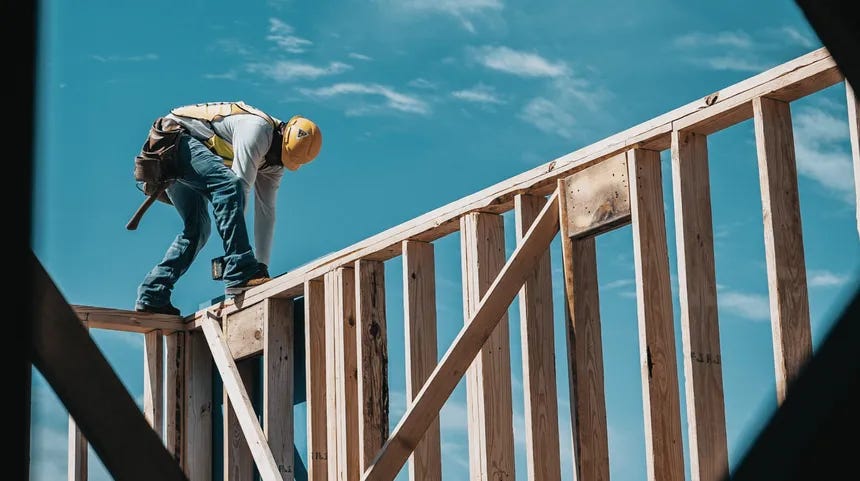
We were often on remote roads, our isolation confirmed by the stillness at noon when all the sawblades spun to a stop. If the day was hot, lunch passed listlessly in the shade on a stack of lumber, our voices among the murmur of insects, finches in the brush, and red tails crying in the thermals above. In response to a morning’s imposition, we would lay on our backs facing the sky with a laziness better described as a careful portioning of energy. No one stirred an inch when an old gentleman appeared on the street above, looking down at the floor as if we were actors on a stage. He always came at the same time, just as we were about to stand and get back to work. Someone would say, “The supervisor is here” but no one knew what he wanted, and no one felt like climbing up to the street to ask him. For the first few months of a spec house, we were always on our own. No architect, no homeowner, no tradesmen for months yet, not even the real estate agent could be bothered. Except for a rare passerby, our little fiefdom was uncontested. We had no plywood barricades, nothing to deter the outside world, except, maybe, our rough appearance as working men. Kids from nearby neighborhoods would sometimes steal onto the job over the weekend to scatter boxes of nails. Occasionally a local might brave the hillside to gain the interior, and appear in a hallway, grinning with an “important question.” We’d shoo them off, but whether we liked it or not, we had to assume everyone within a mile had an opinion about the new house going up. Unlike things made in shops and factories, the building of a house is a public process.
By default, the carpenters, and especially the foreman, became a project’s caretakers, entrusted with its housekeeping from beginning to end. The foreman’s personal habits determined a jobsite’s appearance. And even if he himself wore tattered jeans and a dirty t-shirt, neatness was in a carpenter’s DNA. A practiced domesticity was the telltale sign of a happy crew. Everyone enjoyed the aesthetic of a tidy floor. Our default proprietorship meant that floors were regularly “scrapped out” and swept. By comparison, on a tract house jobsite, with its different crews for each phase of building, the “drop” often lay where it fell from the saw. But for us, not even a light coating of sawdust was always acceptable. Most of us liked to sweep, which was the lightest of labor—and though no one would be caught admitting it, it felt a bit like dancing. For me, sweeping was always a contemplative transition from one phase of work to the next, and we wore out brooms, of which we had many kinds. We built scrap containers near the street, an easy throw from the house. The radio was also a domestic occupation for some one member of the crew, though it quickly became a shambled, if still-functioning wreck, and subject to rough customizations. Carpenters brought chairs for their personal use from home, and a disintegrating Barcalounger might follow us from job to job, till one winter turned it into garbage.
One night at home, sometime after midnight, I woke to the sound of a storm, blowing outside with violent insistence. Though it was not like me to think of the jobsite after I had left work at four-thirty, on that night I woke, sitting upright in the dark, thinking of the storm, and trying to remember how secure I had left things that afternoon? Were the upright walls even braced? I wasn’t sure, not well enough to get back to sleep. So I got up at 2AM, dressed, and prepared to drive across the city, and up into the hills. Dark, wet, empty of traffic, the streets were everywhere strewn with the wreckage of tree limbs, some so large they covered most of both lanes but a narrow passage on one side. And everywhere the streets were alive with the horizontal motion of all kinds of debris launched into the air and across the pavement. Garbage cans, newspapers, and flocks of leaves dancing in zigzag formations. When I parked, and half-climbed, half-fell down the dark hillside, the half-built house seemed completely unlike its daytime version. In the moonlight, its taller roofless walls were flailing, animate, thrashing like a ship in webs of lumber and shadows—the wind like an enormous hand testing the corners of a plywood stack, tossing plastic buckets downstairs, and smearing a drop-cloth to a wall like a shroud. One stack of plywood we had left entirely unsecured had been taken up bodily by the wind and distributed like a deck of cards down on the hillside below. I spent an hour in the dark, soaking with rain, hammering braces, securing piles, clambering through the dark till I had gone through the list of all the things that I could think of to do, then gave up, and drove home and back to bed.
Our exclusive tenancy of a job lasted three months, and then the plumber showed up, and the other trades in quick succession. Whoever eventually bought the house, we never met. Doctors, lawyers, CEO’s. And if for the duration of construction, we imagined we had something in common with whoever would purchase the product of our labor, the truth was that we knew nothing about them—nothing but what an empty new house can say about its buyer. Unlike an old house, a new house hardly has the time to inscribe on its essence the habits of its inhabitants, which, in our case, were limited to the habits of the crew who had brought it into being. The house was unhaunted. But for the duration of our inhabitance, we rented its amenities with our labor—its seclusion, its forested setting, and its three-bridge view, with none of that peculiar satisfaction of ownership. In fact, the attenuated view with its tiny distant bridges, seemed somehow to me to be a reminder of the difference between ourselves and its eventual owners. The houses we built were larger than tract houses, and costlier, and each was built one at a time on a single lot. But like tract houses, they all had the most unobjectionable and uninteresting exterior appearance. And the lots the houses were built on dropped so precipitously from the street, they had nothing resembling a yard. Standing on the street you could see the driveway like a short bridge to the front of a garage and an adjacent entry deck with a front door: very utilitarian. But if a single oak tree, protected religiously during construction, rose up to grace the front of the house, everything was transformed. Unfortunately, most trees fell within the perimeter of the foundation, and met the chainsaw when the lot was cleared.
Toward the end of a project, as the signs of our coming departure began to accumulate, we were reminded that we would leave this house like all the others, and that what we were building was, after all, a commodity. When the real estate agent appeared, confusion was banished. First thing, she wanted to know the overall square footage of the house? How many bedrooms did it have? What was the make of the oven and of the refrigerator? I had no idea—I hadn’t even thought to count bedrooms. It seemed that my knowledge of the house, of the structure I had raised into actuality, was notable for its gaps. And these, I was told, were the most salient features of a house for sale, and the reasons for which someone might either purchase or not purchase it. And though she never said it to my face, her meaning was obvious: that these were the house’s most important characteristics unlike our amorphous contribution. The first time I heard those words I experienced a kind of outrage—I was possessed of working class ire. And though my ire was not something for the real estate person’s ears, I stormed off to light up a laborer with my opinion. The rise of the house, the phases of its construction, the moods of its workers, the change of the weather and of the season, all these had conspired to make me believe that, from its very first days, the house was ours. But I was wrong—and about the time the kitchen had a sink and a stove, and the bathrooms had a toilet, it began to dawn on me that we’d never be using any of these appliances.
If your only reference for the building of a house is tv or the internet, you can get the idea that a carpenter is merely the fastidious disciple of a demanding scripture. Or worse, you can come to believe that the best carpenter is the most careful shopper, and not the one for whom the trade is manifested in the way he stands and moves, as an intelligence in his hands. For the journeyman, an instance of something to be done is always similar to something he has done already, as well as different. Both typical and atypical. As a consequence, and unlike what you might glean from watching Bob Vila, improvisation is always present, though you’ll never hear it on tv: “Well, boys, let’s just wing it.” Most architects hold onto the idea, like a fervent wish, that the coming together of building materials and architectural drawings might be accomplished immaculately. Whole schools of design exist in which the central aesthetic accomplishment is to conceal the work of the human hand. But an exceptional set of plans will show not only what an architect chooses to include, but will also leave undescribed what he, in modesty, leaves for the carpenter to interpret because the carpenter, unlike the architect, has an intimacy with the physical site. But architects are not modest people. And so building plans are often not only the description of a building, but often take a stab at representing the processes of construction, though rarely prescient enough to anticipate most vicissitudes of circumstance. As a consequence, the carpenter is always situated in a leveraged place somewhere between a set of plans and the world of things.
A house is designed and built of knowledge and traditions that never appear in architectural drawings. What is a window? What is a door? So common as to be invisible to the carpenter, who follows them in fidelity to an idea of the trade conceived of in his apprenticeship. Nowhere on a set of plans does it specify that the floor joists should be “crowned” but the joists are crowned and installed alike, meaning that the carpenter must sight along each joist and determine the slight curve along its length, up or down. This kind of knowledge is not “spec’ed” on the plans, is nowhere but on the job, carelessly handed down through generations from journeyman to apprentice. You can see it in the careful etiquette of working men moving heavy things together. In his shortcuts for doing math. In how he accomplishes a fit without using a tape measure. But behind his tradecraft are the other larger questions: What made by human hands can last a hundred years? What but a house pays as much attention to human nature and the human form? What but a house changes so gracefully to reflect the character of a single being? Houses are the receptacles of human habits. Houses possess personalities—in a combination of the architect’s plan, its situation in the world, and the habits of its inhabitants, who usually make it their business to make it suit their needs. These were precisely all of the things that the crew did as the house was built—if the house was haunted, it was haunted first by us.
Even a poorly built house takes a lifetime to fall down. Rot can take decades. One job I remember, a house early in my memory of building, had an abandoned house next door, tucked back into the woods, hardly visible from the street. And one morning we took an informal break to check it out. Even then, I had already remodeled many houses, damaged houses that our efforts had brought back to life. But this house, forgotten in the woods, had sunk to a level beyond the possibility of repair. You could tell from its design that it probably had been the oldest house on the street. And unlike all the other houses on the street, it was built on the one lot that was almost flat. All the windows were broken. The front door was uncloseable, and hung from a single hinge. And although the decrepitude of the house indicated its abandonment had taken place been many years earlier, the refrigerator, mysteriously, still had food inside, black and moldy. All the furniture seemed to be in its original place, heavily coated with dust. In the middle of the living room, the floor joists had given way to an enormous hole, through which the soil beneath was visible and where pale white plants were flourishing. Who had lived in the house? Why had they left? Where had they gone? Everywhere was mold and rot and questions.
When I look again at what I’ve built: a house, or a table, or a dresser, it is hard not to remember, for example, Dave at the window, outside on the scaffold, splitting a shingle with his knife, and slicing his hand so deep we had to drive him to the emergency room. Or the anxiety I felt when all the pieces were dripping with glue and I had only twenty minutes to put them together. Or how I fretted, planing down the drawer box that somehow wouldn’t fit on its glides. Even when I walk into a room that I have never been in before, it’s not unusual that I think past all the things in front of my eyes—the couches, lamps, and tables—and back to a time when the room had no furniture, had no windows or doors, and you could see without effort through all the uncovered walls, through the bare upright studs to the kitchen in the far corner of the floor. A kitchen that was not yet a kitchen. And I can’t help but think of the men who, for a while, lived in those rooms, before they became fit for habitation, and I wonder who they were—what was the time of year? And then I put myself among them, out of habit, like a spook among spooks, laying down the faint traces of our usage, the life of the house before other more distinct habits would come and wash away the memories of the men who built it.
(Working man is 100% AI-free and free to all subscibers. Posts every other Tuesday.)
It’s always a nice escape to read these posts. I only read or listen when I have a moment to really focus - they are not something to have going on the background. This one wonderfully captures the sacredness of houses, the lives that “haunt” these spaces in various ways. I experience the same thing. And I couldn’t help but laugh at the humor in driving across town at 2AM because you know you won’t sleep until you know whether you really forgot to do something important. I thought I was the only one who has done that :-)
My Sunday morning treat. Thank you for writing and sharing