
21. The '91 Firestorm
Work, Men, Muscle, Weather: A Memoir of Building Houses

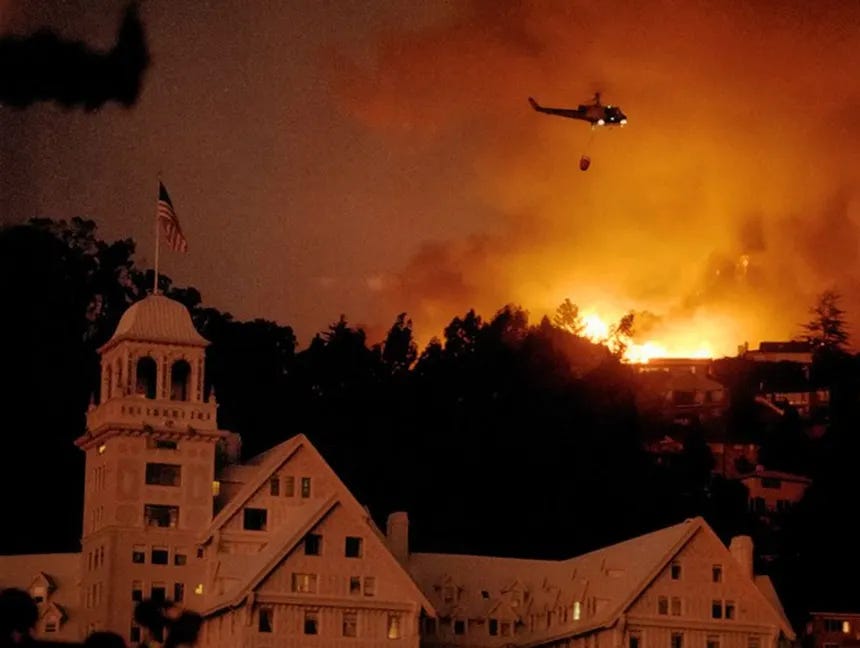
When the 1991 Oakland Hills Firestorm incinerated close to three thousand structures in northern Montclair and southern Berkeley, I was working on a house only a few blocks below the ridge where the monster finally faltered and died. Days after the fire, from the upstairs window of the house we were building, the view of the immediate neighborhood was immaculate, undisturbed. But on the other side of the ridge, all had changed. At the time, I was also living in a cottage in Montclair, and on the lazy Sunday morning in question, the air became infused with the smell of smoke. It was not the smoke of a barbecue or burning leaves—it was a sharp, concerning smell, like the smell of paint being torched off wood. We consulted with a neighbor, and he drove off to soon return with a story of smoke and fire to the north, coming our way. A policeman told him we should get out. Soon a police vehicle with a loudspeaker toured our streets with an evacuation order, but we were already packing. I nailed sheets of plywood around the bed of my truck to increase its capacity. There were fifty steps from our cottage to the street. I had a friend who later reported abandoning his apartment with only a copy of Shakespeare.
On the opposite theory, I stuffed everything worth anything that I could fit into the back of the truck, everything I’d have to pay for a second time—my sentimental criteria. As we drove along Montclair’s main drag, bumper to bumper with everyone else fleeing the hills, all four lanes of Mountain Boulevard were going in one direction out of town. People ran on the sidewalk. The smoke was thick around us and behind us, blowing in the direction we were going, as if chasing us from our homes. For us, the evacuation was orderly, but appallingly claustrophobic, so tightly packed and slow moving was our truck among the other vehicles. With no clear idea of whether the fire would overtake us as we crawled along, it was not until we crossed Highway 13 on Park Boulevard that we thought we might consider ourselves returned to safety. We went first to a church refuge, but then realized we couldn't leave a truck loaded with all our stuff parked on the street in downtown Oakland. We ended up at my parent’s house in the Elmwood district of Berkeley, where technically they had evacuated, but were not immediately threatened by the fire, though the fire was only a few blocks away. As it got dark people stood everywhere in clusters on the street, looking up at the fire and smoke and helicopters dumping water in the hills. From a deck on the roof, we saw gigantic flames threatening to descend onto the ten-story Claremont Hotel, which happened to be the largest wood building in California. It was rumored on the street and in the news that if the Claremont went up, the rain of falling embers would cut a swath through all of Berkeley. We stayed up most of the night, ready to leave at any moment, but late in the evening, the winds died down, and some control over the fire was established. In a couple of days, we went home. The cottage had not burned, though the fire came within a block. I carried everything back up the fifty steps. The next day I walked along the forested street above our rented cottage to a point where I came out into a vast deforested zone with not a single house intact, only solitary blackened chimneys standing like tombstones across the blackened contours of a landscape I’d never seen, an alien panorama.
October is known as fire month in California, and the fire began at 11am on Sunday, October 20, rekindled from a brush fire that Berkeley firefighters thought they had extinguished the day before. Northwest winds to fifty mph, the northern California equivalent of Santa Ana winds, whipped up embers to flames rapidly, and an hour later, the fire had ripped through several blocks and engulfed a huge apartment building near the Caldecott tunnel. From that conflagration, it leapt the eight lanes of Freeway 24 that divides south Berkeley from north Montclair, skipped over four-lane Highway 13, and proceeded to burn residences in Rockridge as well as Montclair. House after house succumbed to a fire so large and hot it created its own monster winds, blasting fire through the air: the firestorm effect. At its peak it was reportedly destroying a house every eleven seconds. Ash and embers rained down all over Oakland and Berkeley, and as far away as San Francisco on the other side of the bay. Many times firefighters advanced on the fire and were forced to retreat, running out of water in multiple locations. Where the fire originated, there was little warning, and the evacuation was chaotic, taking place amid huge wind-driven flames burning houses on both sides of the street. Many were forced to abandon their cars to flee on foot, some unsuccessfully, and run down by the fire. Twenty-five people lost their lives, and hundreds were injured. Stories of close calls while evacuating were everywhere—the fire was so swift. A stranger and I attempted to find our way back through the burn zone on Sunday evening to check on the status of my little cottage, and we made it as far as an unsupervised area, completely devastated, where the fire was still casually burning through houses but apparently without the urgency that required the presence of fire department personnel. There were none. It was shocking to witness. And soon enough, larger flames turned us around. The whole of the bay area was glued to the tv news, along with the country. We stayed up late in the night fearing the worst. The news was full of the Claremont Hotel, frightfully near the flames—but that was where the fire was stopped, just short of an unimaginable disaster.
The fire’s aftermath looked exactly like what has lately become a familiar sight in the news: a chaotic inhuman order imposed over an immense bare blackened landscape—a reckless, pitiless excision of the flammable from the inflammable. Everything that could be burned was burned, with arbitrary inexplicable exceptions that mocked human understanding. When we saw sixty-foot flames threaten the Claremont, it was impossible not to ascribe agency to its ferocity. In the aftermath, the authorities sprayed poppy seed everywhere to protect the hillsides from erosion—the seed was a mocking artificial-turf green spread thinly over the black of devastation. The next spring, in a further irony, the fire zone blossomed into flamboyant fields of poppies. I made an attempt to visit all the houses I had built destroyed by the fire, but mostly, it was the strangeness of revisiting what was no longer there, an absence. Not only had each house completely disappeared, but the surrounding neighborhood where it had stood was unrecognizable. I thought, at a minimum, I would be able to get out of my truck and contemplate the ruin of my energies, but instead it was difficult to know for sure if I had even returned to the right spot. Everything had vanished. A carpenter has little control over how beautiful or unbeautiful is the house of his labor. As a consequence he relies on its simple standing presence to assure himself that his efforts have come to something. A house may change over time, but he takes for granted that the difficulty and expense of wholly removing it assures a permanence for the years of his life. So, I didn’t really feel sad—it was more like the vexation of seeking and not finding the evidence I had done anything at all. Compared with the real grief of those who lost everything, it was nothing, I know. As I stood in front of one of those empty locations where I had once built a house, I could also see the more substantive ruin of a neighboring house—with an unusual steel structure for an underpinning—and when the fire had barreled up the hillside with its negating heat, its steel I-beams had simply melted into a deformed clump of worms.
So, we finished the house we’d been building, and started another the next spring—but this house was in the burn zone, and a stone’s throw from the origin of the fire. Sally had been the builder of both projects—we must have been among the first few to rebuild. The job was to repair the concrete foundation damaged in the fire, and put a new house on top. The poppies (pink or orange?) were thigh-high and so thick, it was a chore just to wade through them to get around the foundation, but eventually our comings and goings flattened them down into a green carpet. Our first task was to jackhammer off the upper part of the foundation and replace it with new concrete, new bolts, and a new mudsill. A "mudsill" is the wood member bolted to the top of a foundation that provides a strong connection between the wooden house and its concrete foundation. This mudsill had been entirely burnt away, its bolts untrustworthy. In many places, the color of the normally gray concrete was burned a strange pink that I couldn’t explain. In spots, it was cracked and had sloughed a surface layer. Jackhammering concrete is nasty, painstaking work, but Benny and Lorenzo took turns. We kept discovering oddities that represented to us the story of the house’s undoing: Postholes in which the fire had burned the wood of the post entirely—two feet down to the bottom of the concrete hole. And inside the perimeter of the foundation, where the smoking roof and floors had collapsed one atop another, the things not made of wood had sifted down, hidden in the piles of ash beneath the poppies. A cache of pennies, its dish and bureau gone. Half of a silver tray. A coat hook. A dumb bell. A satellite dish. A gold ring that we returned to the owner. And outside the perimeter of the foundation, we found three odd locations marked with an X of caution tape, each pinned to the ground with gutter spikes. These, we learned, marked where someone fleeing the fire had succumbed, and the remains were found. Two of the three were tucked up beside a foundation wall, as if some bleak respite had been found there. All three were off the road and down the steep hillside, inhospitable in the best of circumstances, but where, I suppose, they were driven by the intensity of the fire, hoping somehow to escape it. It was impossible not to think of those horrible last moments. We never touched those X's, thinking someone from the city would return for them someday, but they never did.
Tradesman from all over California came to rebuild the Oakland/Berkeley hills. Montclair became a boom town of sorts. I talked with a plumber who lived in Fresno, and everyday commuted back and forth, six hours. The cadre of spec builders who had worked the hills for years were bidding on and winning house contracts—probably because of their proficiency on steep lots. This period, of course, was long before the recent decision of insurance companies to discontinue offering fire insurance in California. Indeed, after the fire, some homeowners had such poor coverage they could not rebuild at all—forcing them to sell their lots. But others had “replacement value” insurance policies that paid freakishly large awards. For example, many old Rockridge homes had been originally constructed with old-growth redwood for all the framing lumber, and redwood, once local and cheap, had acquired the value of gold, resulting in huge payouts. As a rule, all new homes were built as deep and wide and tall as the homeowner could get away with. At the peak of new construction, you could easily see twenty to thirty new houses going up at once. I was the foreman of four houses in the burn zone for four different builders, and did the finish for a dozen others. It was my observation that homeowners, traumatized by the fire, commonly looked on rebuilding in the fire zone as an act of audacity, of personal bravery, and I could hardly fault them. Even those with the best insurance had had their lives put into a turmoil by the fire. Many were especially reluctant to put a fireplace in the new house. One homeowner was so shaken by her experience, she chose to put a decorative fountain in the living room where a fireplace normally would have been.
Representatives of OSHA (Occupationl Safety and Health Administration) found the new concentration of jobsites easier to police, so steel scaffolding was mandated. The carpenters union, never a presence before the fire, also made an effort to conscript workers. It was a time of transition. I was working for Sally in the burn zone that spring, and I must have been harboring some resentment for her because of the previous job in which she had forced me to endure Jimmy the plumber for the weeks it had taken him to finish his plumbing. (18. The Foreman) But also, on the same job, she had hired an awol sailor for a laborer, who, as we learned afterward, she was having sex with. I must not have taken enough care to address his elevated idea of himself, and within a day, he actually attacked me, just as Jimmy had. Never before or since had I been attacked on the job, and here were two lunatics on a single job, both employed by Sally. So, one afternoon, months later on the burn zone job, Sally was questioning me about our efforts of that day, and my reply was that she should get off the job and let us do our work. I said it, knowing perfectly well what would happen. After Sally, I worked with an architect on his one-time spec project, the job on which Brad had taken his fall. (20. The Crew) And lastly, in the burn zone, I hired on with a spec company that had bid many, too many, new projects, and had won them all with low bids. They were good framers, but got bogged down in the finish, running out of money—so I was hired together with another carpenter. But they were so far behind, they had to send the two of us to three projects a day in order to put on a “show” of getting something done. We drove up to each job, set up all the tools, a tablesaw, two chopsaws, two nailguns, and a compressor, made a few cuts, made up a few joints, and then packed all the tools again to go to the next job.
As houses were rebuilt, the woodland character of affected neighborhoods would never return. No one wanted it. As the fire spread, pushed by wind, it had jumped from tree to house to tree to house. Video of the fire makes that assertion incontestable. The non-native Eucalyptus tree, said to be full of flammable rosins, became a major villain in explanations for why the fire was so savage. So rather than the woodland character that emphasized wildness and arboreal splendor, the new houses were much larger, built out to setbacks. Instead of cedar shingles, and wood siding, they were clad in stucco with tile roofs, vigilantly fire-resistant. Instead of forest rusticity, the new aesthetic was Mediterranean, said by some to be the true reflection of the East Bay climate. Well, it was different, for sure. Although irrational and sulky of me, I much preferred forested Montclair, which was its original pristine condition when San Franciscans began building summer homes across the bay over a century ago. Another upshot of the fire was a careful review of the response by the Oakland and Berkeley Fire Departments that resulted in significant upgrades in terms of water availability, equipment, and readiness. And since the firestorm, similar instances of brush fire in the hills have been extinguished rapidly. The knowledge gleaned from the 1991 Oakland Hills Firestorm became a model for fire departments everywhere, including, no doubt, Los Angeles. The long period of rebuilding in the fire zone dragged on for more than a decade, and Jeff’s retirement created some instability for me, although work was everywhere. The continuity of my own story suffered some solvable challenges. Spec houses were temporarily derailed by the emphasis on rebuilding, and I began to have the feeling I had been kicked out of my own home. But carpenters and fire have a long intimate history, and some carpenters make a specialty of fire jobs, though it always sounded like filthy work to me. In fact carpenters tend to show up after any disaster: earthquake, flood, tornado, as well as that slower combustion of rot and decay. You could say that the carpenter was obliteration’s natural opposite—quick to put things in order and begin his sweeping, solving one small problem after another, talking as his hands worked. You could even say that carpenters and fire were natural enemies if it was not so appallingly clear that they were also natural friends.
(Working Man is 100% AI-free and free to all subscribers. Posts every other Tuesday.)
"Concrete exposed to temperatures greater than approximately 570°F often turns a shade of pink, associated with chemical changes of the iron-containing compounds in the aggregates and paste matrix. At much higher temperatures—which are not commonly encountered during typical structure fires—the concrete can turn back to a light gray and then eventually to a yellowish-brown color. Concrete that has turned pink is damaged and should be replaced."
My engineer brain couldn't resist looking it up!
A different feel to this chapter - because the family is involved, rather than the crew?
We have a builder friend who built his own house, lost it in a house fire, and rebuilt it again himself. He just "moved forward", where I think that may have destroyed me.
An interesting take on a historic event!
Your jarring visit back to the homes you worked on that were no longer there reminded me of a sad trip I made to the SFO Bay Bridge after the old Eastern Span had been demolished in favor of the shiny new suspension bridge. I spent two of my peak years crawling over that 1920’s metal structure in the cold and wind and fog and it was just gone. It became plain to me then that very little is permanent in the world of men.