
20. The Crew
Work, Men, Muscle, Weather: A Memoir of Building Houses

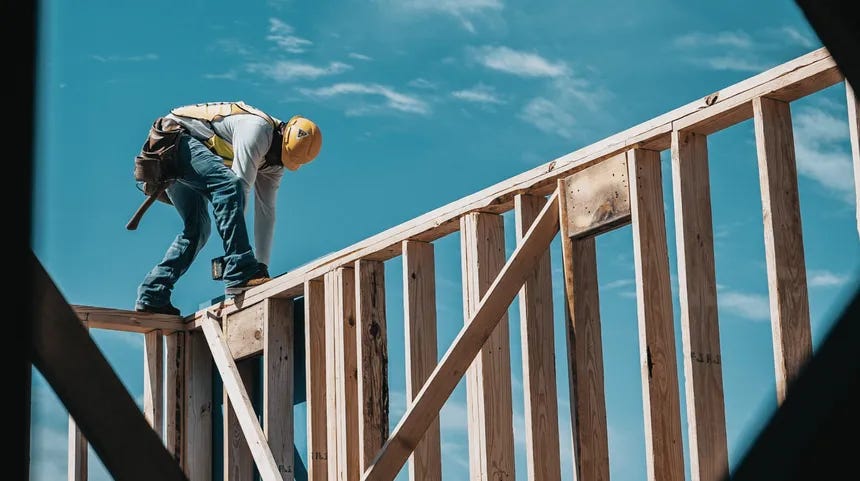
Of the hundreds of men I worked with over the years, I really only remember the handful I spent the most time with, the men who stand out only because they were the men I knew. It is the problem of eulogy: what can or should be said about a man? They were ordinary men—and so, resist description. I think some of us, me especially, owe a debt to those milder souls who permit us to pass through a corner of their life unmolested, whose forbearance gave us permission to be. I guess the thing that must be acknowledged is simply that they were, all of them, very good to me. I was lucky. I have long since lost track of each and every one of them, which, no doubt, implicates me as the shepherd whose flock wandered as he dozed. Thinking of them now, I admit, induces an apathy as well as emotion because we were together so long, despite the intervening decades, it is as if they never left. As if now I could merely raise my eyes to their presence. We parted on good terms, and then, they were gone, and I was not upset. During the decades of my time in construction, there was not a trend or progression to better or worse, it was more like I was riding the waves of an ever-changing sea in a very small boat. And when the waves got higher, people disappeared.
Dave and Brad were cousins from Antioch, a working class town just outside the bay area. Gentle joky men, Brad was an apprentice, and Dave, a journeyman, and both were terminally passionate about tv football and baseball. Between them, they accumulated a small mountain of statistics about players, teams, sports history. And for their sake, I revived my childhood enthusiasm for baseball, just to be more a part of them. While we worked, we listened to day games of the San Francisco Giants. During this time I was, by lucky accident, auditing a graduate poetry workshop at UC Berkeley, and in my mind, I could not help but compare the intellect of the PHD students I knew with the men on the job, particularly Dave, who seemed to have uncultivated natural gifts. Dave looked older than his years, and had the sallow wrinkled complexion of a man who had had some kind of drug abuse in his past. Whatever it had been, it was over by the time I met him. He liked country music, and we listened to a lot of Merle and Hank. A great storyteller, Dave had Gene’s habit of talking all day long, simply to amuse himself. His was a peculiar and penetrating humor. As the music played, he demonstrated a poet’s sensitivity to the sound of words, singing along as Merle, in “Working Man Blues” wrung every bit of country out of his rhyme of crew and use and shoes with blues:
Brad was younger, quieter, sensitive, and serious, as an apprentice needs to be—solidly built, with long eyelashes, and eager to learn. The last time I saw Brad was after the ’91 firestorm. We were building a spec house we had already framed up, and we were working on the garage roof. Dave wasn’t on that project—I don’t remember why. So, very likely, this was Brad’s first chance to function as “the second” on a jobsite. We were in the middle of what had been an enormous zone of houses incinerated to ashes by the firestorm. When we got started, it was like one giant construction site with houses going up everywhere. Anyway, I had left the job to pick up lumber—and when I returned, the ambulance had come and gone. The crew of the house next door had heard Brad’s cries. And apparently he had fallen from the garage roof onto an exposed concrete foundation tie beam, breaking his leg in several places, and nearly severing a hand. He never returned to work, and I heard he began driving a forklift. I never saw Dave after that either.
People disappear. And now, here I am, many years later, trying to conjure up those who were so near as to be unnoticeable. And I suppose it is a special quality of men, and not women, who can spend a decade shoulder-to shoulder among other men, and think well of them, but without experiencing any desire to know them any better. If my affection was of a moderate proportion, it was also tolerant to a degree almost negligent. In our day to day course of working together, some three thousand days, I was never troubled by their idiosyncrasies, and never felt an irritation that I wanted any one of them to be any different than what they were. When I found out Lorenzo (Chapter 11.) was attending AA, I hoped and wished that things for him would turn around, but really AA was not the cure he needed. Some men have such large hearts, they either find a place for all that passion or they’re pretty much doomed. I knew what a wonderful husband and father he might have made, all that eros turned to goodness, but I think it would have been hard for a woman to love that face. Maybe not, I don’t know. But rarely did I feel any curiosity about these men with whom I spent more daylight hours than my wife, and I’m certain that they felt no differently about me. In our happy band of brothers, there were no questions or confessions because no one really wanted to know.
Benny was a black man from the Virgin Islands: tall, broad-shouldered, very handsome with a melodious Caribbean accent. I had heard his success with women was legendary, but not from him. He himself was discreet, mild, and soft-spoken, and walked with a dignity that was entirely unaffected. When his more flamboyant friend from the islands, came by the job, the conversation often turned to “side” women, and then, we’d get a better idea of him and what seemed a universal institution on the islands. He loved Calypso and made a disc for me of The Mighty Sparrow when I showed some interest. He shared none of Lorenzo’s passion for work, but did his job well, and they got along fine—with none of the animosity so common between Hispanics and blacks. Jeff’s son, Jay, was built like a bull and had a bullish personality. One day, he must have said something to Benny, and a fight broke out. Instead of fighting, Benny got behind him and lifted him up off the ground. Jay was big and no pushover, but Benny held him in the air, kicking and screaming, as if he were nothing. In truth, I think Benny was just afraid to punch the boss’s son with his fists, so instead Benny merely held him suspended, helplessly unable to give Jay the good pounding that Jay really deserved. Of course, Jay was fired, again. Now that it’s been more than fifty years since working class jobsites began to have employees of all races working together, I think it would be worthwhile considering what kind of racism is left. I saw very little. When men work together, the things that normally determine their opinions of each other, competence and energy, are what dominate the jobsite, and, in my experience, compete pretty successfully with prejudice.
Once in a blue moon, someone brought a cooler of beer to drink (it was never me) and we hung out after hours on the jobsite, feeling a bit transgressive in the place where our more productive daylight hours were spent. We may have made it to a bar together one time, but the moment is not really clear to me. The terms in which we saw each other, and judged each other, were not so much personal, but had to do with the work itself—and though the situation was intimate, just the five of us, most every bit of the relationship was determined by the roles in which we found ourselves together. It was easy that way. I knew Dave’s wife was Linda, and he might refer to her occasionally, and so contextualize an indefinite image in my mind of “Linda” but I never met her. If it had been a question of loyalty, I have no reason to doubt our fealty to one another. The kind of trust you grant, in which your own safety is dependent on your correct assessment of another man, that’s the kind of trust we had. Two men would walk the narrow tops of two parallel walls holding a twenty-foot joist between them, and if either man lost it and fell, both fell. Everyone was eager to get home after a long day, so when the sun approached the horizon, we all made our excuses.
When I met Rogelio, he was in a line of ten men, of which I was to choose a helper. We were building a small mall complex in Mill Valley. It was my last ten years in the trade. Rogelio was small, and when I asked him to drive a screw with a driver-drill, he couldn’t do it to save his life, but he spoke perfect English and he was smart. When we finished the mall, I brought him to my next job, and after a couple years under my tutelage, he became a journeyman, and eventually a crackerjack finish carpenter. He was still sweet and innocent. It’s amazing how a blowjob can change a man’s life. He and his new wife lived in a cottage in the backyard of the house his family owned. Then one day after nine years together, he told me he had been deported. Just like that. Apparently, his family had brought him into the country at the age of seven. I did what I could. I talked with his attorney and provided an affidavit of his expertise and steady employment. I even managed to get a few of our richer clients to donate to a small fund to support him in his early months in Mexico. I knew at the time, and I know now that illegals reduce wages and take jobs from Americans, but Rogelio was family. I was on his side even if I knew it was wrong. Last I checked, the construction industry was fifty percent Hispanic, and democrats actually have the gall to ask who will build American houses without illegal immigration? Rogelio couldn’t remember a thing about Mexico. After six months, he and his wife returned, illegally—about the time I was retiring.
In later years, when lunch came, I sat with the crew less often. It wasn’t so much of a desire to be apart from them as it was a desire to be alone with myself or with a book. I would drive my truck a few blocks away, park, and sit by myself for the half hour we had for lunch. I knew at the time that this was not so great for morale, but I was in my fifties, and whatever authority I had established, had been established years earlier. When I think of all of them now, my memory tours a series of familiar scenes. One winter was particularly cold. It had snowed the day before which almost never happened in the Montclair hills, once every five years or so, and only up on the highest part of the ridge where we happened to be. Most of the snow had melted but there were still remnants of it lingering in the shady corners. The house was half-built, and the rooms we had framed were dark and damp with melted snow and rain. The roof was a month away. As we passed each other in the halls and in the bedrooms, we could see each others breath in the air. Someone said maybe we should build a fire. Everyone was freezing, but it wasn’t raining, so there was no chance we were going home. Up on the street we took a steel garbage can, filled it with scrap, poured chainsaw gas over it, and set it ablaze. We all stood around it with our palms raised, grateful for the warmth. Dave, Brad, Lorenzo, and Benny. And it was just like me to find myself thinking of all of us standing there together: the faces and hands, the jokes, who we were to each other, and all of us, our minds mostly on the moment when we would soon have to leave the comfort of the fire and return to our various jobs. And soon, we did. But for as long as the fire lasted, for the rest of the day, we would each find an excuse to go back up to the street and warm our hands again for a second.
(Working Man is 100% AI-free and free to all subscribers. Posts every other Tuesday.)
I decided to remove the two quotes from this piece, thinking that they were slowing things down too much. One quote was from poet Thom Gunn's "All Do Not All Things Well" a favorite of mine. The other was the full text of the lyrics to Merle Haggard's "Working Man Blues" another favorite, especially for the way Merle sings the rhymes.
"I think some of us, me especially, owe a debt to those milder souls who permit us to pass through a corner of their life unmolested, whose forbearance gave us permission to be."
Beautiful. I wish I could write like this, but it's enough that someone can. Thanks.