
14. Journeyman
Work, Men, Muscle, Weather: A Memoir of Building Houses
The morning after I quit Dee, I showed up at the Happy Valley jobsite. On its own hilltop in Lafayette, it was the swankiest address east of the Caldecott Tunnel. Rick the journeyman who got me the job, introduced me to Dave Katanho, the owner-builder. The story from Rick was that Dave had cut the winding road from the street below to the top of the hill with his own bulldozer. That’s the kind of place it was. The hill was a perfectly symmetrical green dome with a panorama of 360 degrees from which you could easily develop an outsized notion of your own importance. Dave was a big guy—strong and blocky like a farmer, with a square head and jaw and close-cropped hair, with short bangs across his forehead. He was moody, but could be nice as pie when he wanted. I began to realize something was really wrong when one day he got on his bulldozer and tried to dig a hole for a swimming pool in the weeds of the backyard. He went at it for several hours without much progress, but by the end of the day, he had dug a pit about eight feet deep. A week later, when I arrived in the morning, the pit had already been filled in.
The big two-story house had a large breezeway between two wings where the bricklaying crews had already begun two sweeping staircases to the second floor entry. On my last day, they were still working at it. Already they’d completed two giant chimneys, one for each wing, built from the ground up. Except for the roof, the house was framed and sheathed when I got there, and a small crew was setting rafter beams in the living room. But the entire crew included eight carpenters and laborers, as well as bricklayers and other trades. My solitary days with Dee were done. Dave was often on the job, and Jack the foreman was always around, talking with the bricklayers mostly, which was about all he was good for. It was rumored Jack owed Dave money.
If my abrupt exit from Dee’s employ had shortened my apprenticeship, my time as a journeyman on the Happy Valley job was to be shorter still. Sure enough, the first Friday, Dave paid us all in cash from a cigar box that must have held thirty thousand dollars, just as Rick had described. With my pay doubled, I was suddenly rich, and I bought a crap Ford pickup that immediately began to take large bites from my income. The lead carpenter of the rafter beam crew (and senior carpenter on the project) was an older gentleman from Finland named Klaus who got a special pleasure introducing himself as a “finish carpenter” (joke) specializing in “tongue in groove” (another joke) with unfunny lewd wagging of his tongue. The beam-setting crew under his guidance was supernaturally slow, though the beams fit well. As Dee would say: “His work is so fine, you can’t hardly see it.”
Rick and I started hanging windows in the living room near the beam crew, but quickly left them behind, and a day later we were in the master bedroom on the other end of the house. Sometime in the morning, Dave the owner came into where Rick and I were working, and kneeling on one knee in the middle of the room with his eyes closed, he pinched the upper bridge of his nose between his thumb and forefinger. Rick and I exchanged looks. I thought maybe he had a migraine, but he paid no attention to us, not moving for nearly an hour as we set windows with redoubled energy, eager to get out of there. We had just positioned the last window in its opening when Dave suddenly exploded, lifting a full five gallon bucket of paint with one hand and flinging it out an open window as if it were a bucket of chicken wings. Rick and I were astonished. Dave stormed off, but we finished the window anyway, and soon were assigned to lay roof decking on the rafter beams Klaus had installed in the living room. After setting a few decking boards, the roof began to feel like a reassuring distance from the insanity below.
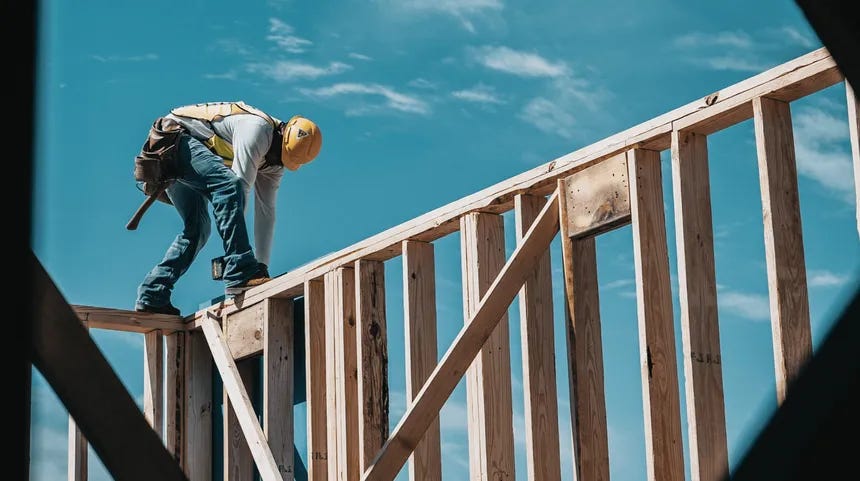
At the end of my first few weeks, it was apparent that the melodrama of the Happy Valley jobsite would be in sharp contrast to my uneventful days with Dee. But—not being the target of anyone’s wrath—I found it more entertaining than anything else. And up on the roof with Rick felt like a separate jobsite. We talked and laughed without fear. Since we were easily the most productive carpenters on the job—in retrospect, we may have enjoyed ourselves and our lack of humility too much. The summer was blistering, close to a hundred in Lafayette, and on the roof, Rick and I were stripped to cut-off jeans, boots, and tool belts. Dripping with sweat, and installing pine decking boards, each board we fitted increased our isolation from the turmoil below and upped the volume of Rick’s ghetto blaster. At lunch we rattled down an aluminum ladder to the cement block utility room which had become the appointed lunch spot because it was the least sweltering place on the whole job, and more importantly, the location of the beer cooler. Never again would I see a builder provide his crew with free beer. On more than a few occasions, Rick and I climbed the ladder back to the roof, not intoxicated but with a two-beer buzz.
When the last boards of pine decking were laid, our isolation was complete. In addition to the pine decking, we were also charged with building a 2x6 sub-roof (a roof on a roof) creating cavities where bat insulation could be installed. And so we worked all day uninterrupted by whatever was going on below, and maybe that explained the direction our labor was to take: All of July we busted ass on the sub-roof, sweating our guts out with Rick’s boombox blasting, getting silly with a good buzz after lunch, and soon we began to organize “block races” between ourselves: a kind of carpenter’s competition to see who can install a long row of blocks the fastest. And then, like those obsessions that strike you in the midst of boredom, our block races became more baroque with expanding variations on the original theme, always ending up with both of us side by side driving nails at top speed. Rick began singing, sometimes to the boombox, sometimes acapella, and frequently a composition of his own to the tune of Davy Crockett: “Da-vy, Da-vy Katanho, king of his very own hill.“ Rick had taken to weaving a circlet of scrap copper wire into a sort of crown that he wore while dancing on the top of one of the brick chimneys that extended up through the roof. It was the summer of the New Wave, and the boombox throbbed: “We are—we are Devo!”
But soon, a disturbance below was large and loud enough to reach the roof. Dave had fired Klaus for a reason I never heard, and Rick, who was Klaus’s friend, was outraged and he threatened Dave with quitting. So without much hesitation, Dave fired Rick, which left me without my only real tie to the job. I spent a boring last day on the roof and that evening I called Dave to express my opinion that it didn’t make much sense to fire Rick who was the most productive carpenter on the job. And then Dave fired me—I guess I half-expected it. I found myself on the street, where I’d never been before. I called Rick that night to get a line on something to do, but he was too busy laughing. He had some side jobs already in the works, and Klaus didn’t care either—he was close to retirement anyway. I was worried about finding work, annoyed with Rick’s unconcern. I didn’t want to call Dee so I called Gene Lance, who was a carpenter who had worked off and on with Dee. As it turned out, Gene was working for Jeff Armstrong, a builder contractor for whom Dee and I had built a couple of houses. Gene said I should talk with Jeff. I showed up the next morning and Jeff put me on that day. He had some projects coming up.
A few years would pass before I came to understand that Rick’s good humor had been a sort of celebration of his own independence. From then on, in the years ahead, it was not often that I would quit a job or be fired, but when circumstances demanded, I never again recoiled. The fallout was always salutary, a bracing reminder that—in this my choice of employment and in this small way—I was luckier than other men. I had not foreseen it. When it landed in my lap, it was pure serendipity. Rick was right to laugh.
First; I'm on my third Ford truck. I drove to work for ten years with a bricklayer twenty years older than me. Very good mason and a good guy. At the end of the day I would throw my tools in the back of the truck, jump in and declare, "you're killing me Junior!" His reply was that "I'm only trying to lay one more brick than you."
"That's funny, I'm just trying to lay one more brick than you too," I replied. We had a reputation, only the good bricklayers would venture to work between us.
Your quote about the “fine” work reminded me of one particular foreman who was full of witticisms.
My two favorites (heartily shouted at full volume): “He does the work of three men: Larry, Curly and Moe!” and on those hungover mornings, “I slept like a baby - woke up every two hours crying!”